U.S. Mortgage Rates: A 50-Year Historical Perspective (1976–2026)
Mortgage rates are often discussed in short windows, but meaningful perspective only emerges when viewed across multiple decades. This analysis examines the U.S. 30-year fixed mortgage rate over the last 50 years, using Freddie Mac’s Primary Mortgage Market Survey (PMMS) as the benchmark, while acknowledging real-world borrower averages during extreme periods.
The 50-Year Extremes (Contextualized)
Over the past half-century, mortgage rates have moved through extraordinary cycles:
-
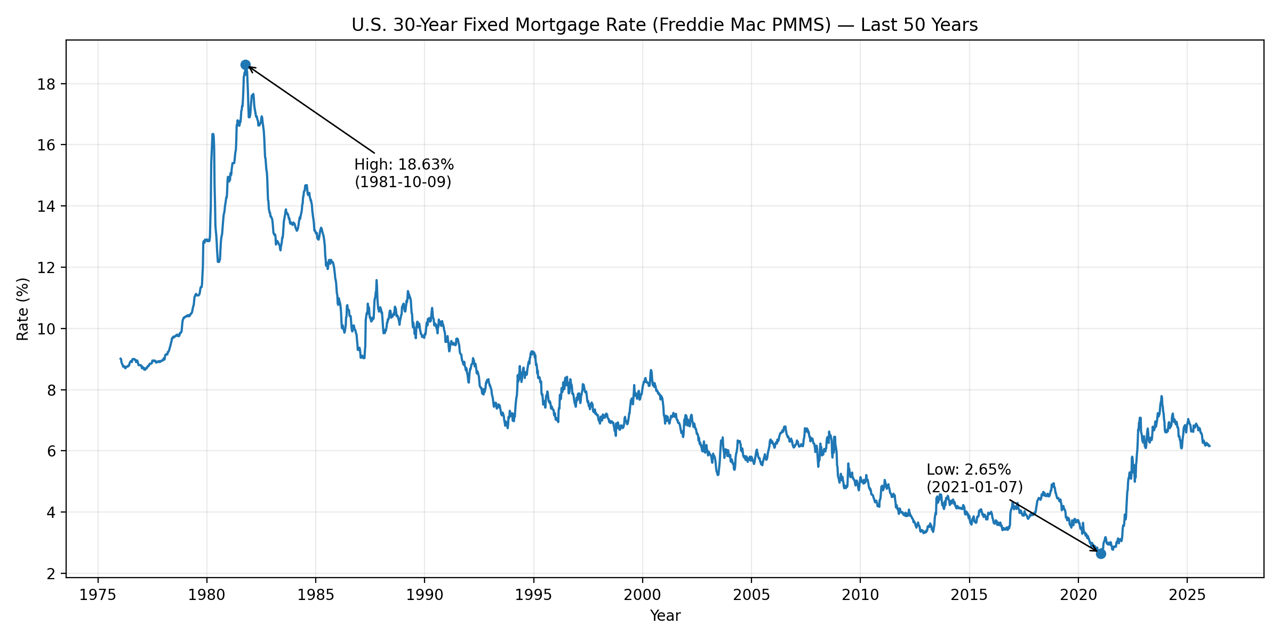
Highest rate: 18.63% (October 1981)
-
Lowest sustained average: ~2.375% (late 2020–early 2021)
While Freddie Mac’s weekly survey recorded a single-week low of 2.65%, borrowers during the 2020–2021 period routinely accessed average market rates closer to 2.375%, making this a more representative measure of the true low-rate environment.
How Mortgage Rates Have Evolved Over 50 Years
Late 1970s–Early 1980s: Inflation Shock
Mortgage rates surged alongside runaway inflation, peaking above 18% in 1981 — the most expensive borrowing environment in modern U.S. history.
Mid-1980s–1990s: Structural Decline
Rates began a long, multi-decade descent, moving from double digits into the 7–10% range, restoring affordability relative to the prior decade.
2000s: Stabilization
The early 2000s introduced a more stable mortgage environment, with rates typically between 5% and 7%, a range many later came to view as “normal.”
2010s: Historically Low by Long-Term Standards
Following the Global Financial Crisis, rates spent much of the decade between 3% and 5%, already low by historical comparison.
2020–2021: The Lowest Mortgage Rates in U.S. History
During the COVID-era monetary environment, mortgage rates fell to the lowest sustained averages ever recorded, with typical borrower rates near 2.375% — a level never previously observed across 50 years of data.
2022–2023: The Fastest Rate Reversal in Decades
Rates rose rapidly as inflation returned, climbing above 7% in 2023 — the sharpest increase since the early 1980s.
2024–Early 2026: Elevated but Historically Moderate
By early 2026, rates moderated into the 6% range, elevated compared to the 2010s but still well below historical extremes.
What 50 Years of Data Makes Clear
-
Mortgage rates are cyclical, not linear
-
The 2–3% era was an anomaly, not a baseline
-
Rates in the 6–7% range are historically moderate
-
Long-term perspective matters more than short-term headlines