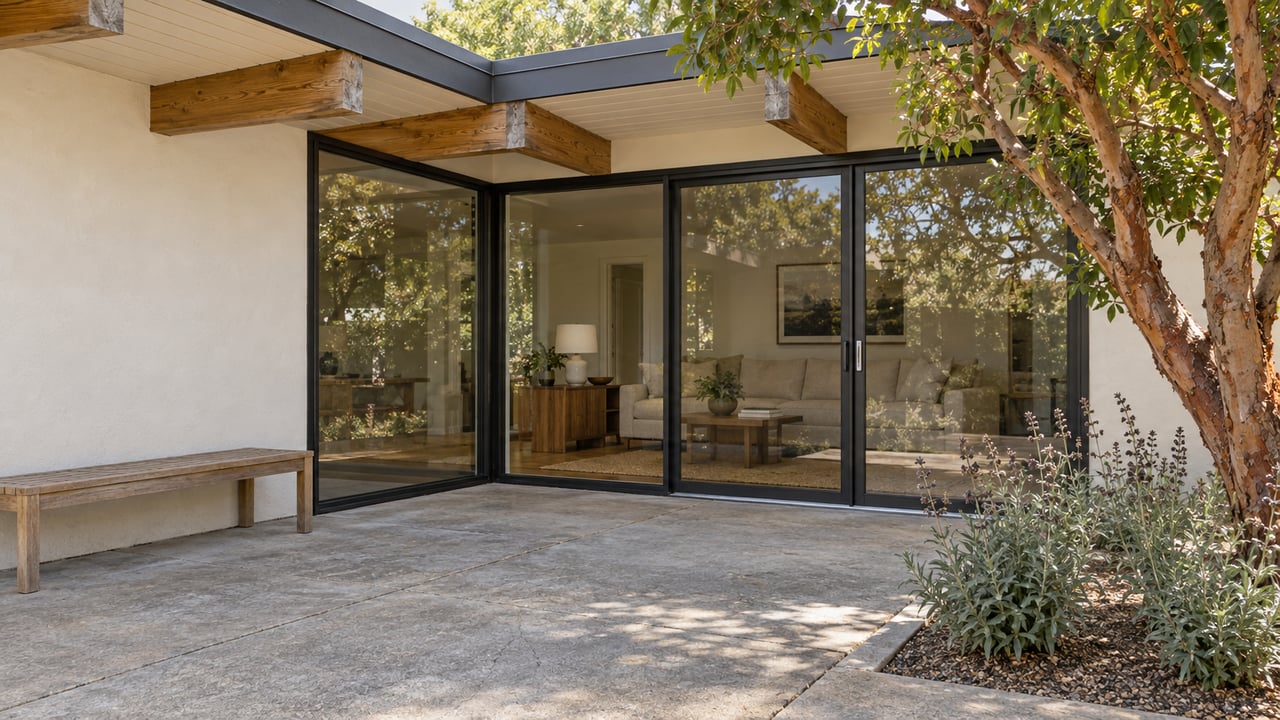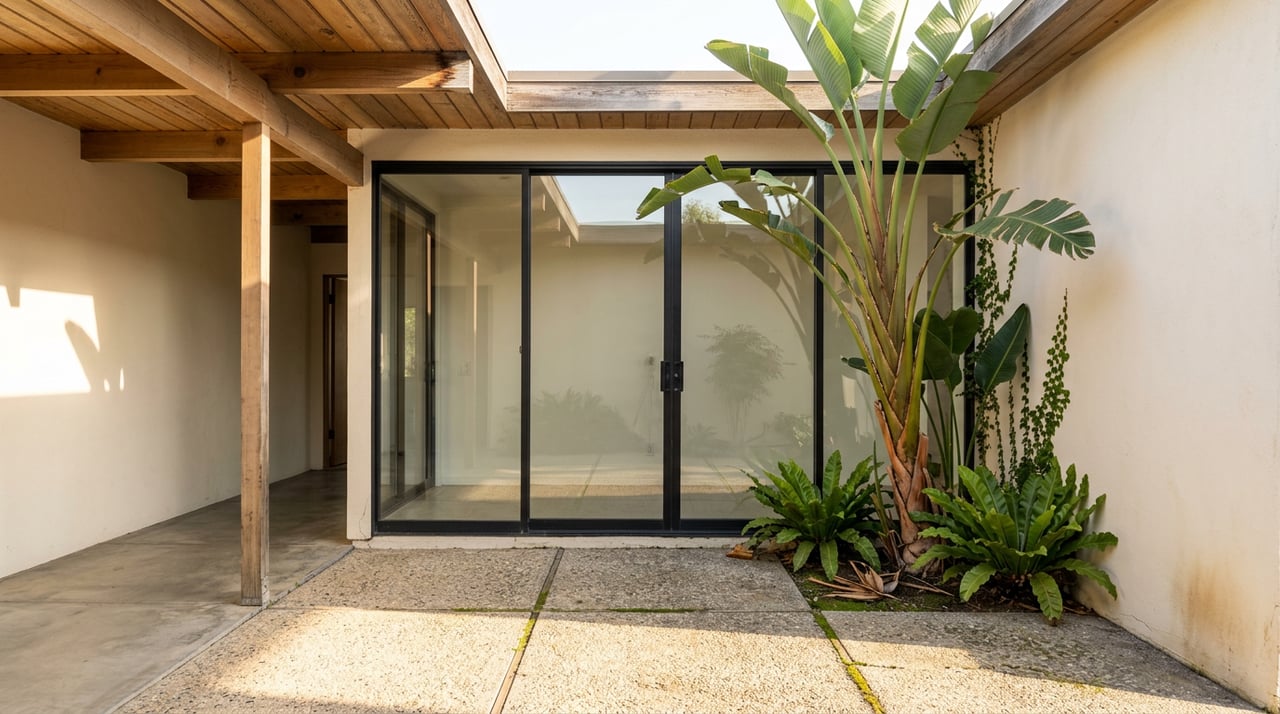
A flat, built-up roof that needs recoating every fifteen to twenty years. Floor-to-ceiling glass walls that turn a January morning into a heating bill. Radiant heat pipes buried inside a concrete slab that can't be inspected without breaking it open. On paper, an Eichler in the city of Orange should be a harder sell than the ranch house two blocks over. In practice, the handful of Eichlers that came on the market in late May 2026 listed at an average of $879.98 a square foot, well above the $686 a square foot Orange County posted overall for the three months ending May 2026. A Mills Act contract can also affect the cost of ownership.
Orange holds roughly 350 of these homes across three historic districts: Fairhaven, Fairmeadow and Fairhills. That's more Eichlers than any city outside the San Francisco Bay Area, and it means buyers comparing them aren't just comparing floor plans. They're comparing what a specific piece of California property tax law does to the real cost of owning one, and that number changes depending on which of the three tracts you're standing in.
What $879.98 a Foot Actually Reflects
Two data points don't make a trend, and the late-May 2026 snapshot of active Eichler listings in Orange was thin, just a couple of homes on the market at any given moment. But the premium those listings carried lines up with what the tract's own history explains. These homes are rare by design. Eichler built only about 575 units in all of Southern California between 1949 and 1974, and the three Orange tracts represent his only Orange County work. Scarcity alone pushes price. What sustains it, especially for a home with original systems that a conventional appraiser might flag as functional obsolescence, is a mechanism baked into the deed.
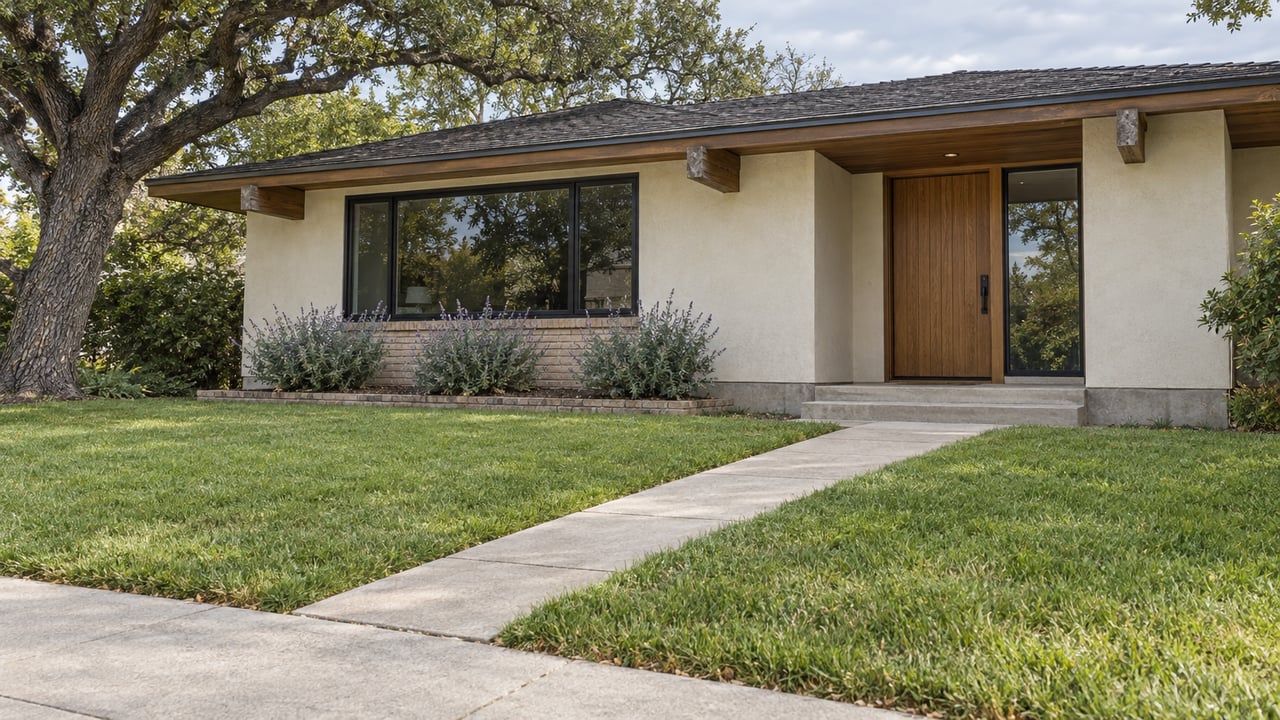
Original features still show up regularly in listings across all three tracts: ball pendant lamps, tongue-and-groove ceilings, vertical wood siding, concrete slab floors, and the open-air atrium entries that defined the model. Those details are why design-minded buyers seek these homes out in the first place. They're also exactly the kind of original-condition elements that make a conventional lender's appraisal, or a buyer's inspection budget, more complicated than it would be for a stucco tract home built the same decade.
The Contract That Comes With the House
California's Mills Act, enacted in 1972 according to the Ventura County Assessor, lets local governments tax qualified historic properties using an income-based formula instead of the standard market-value assessment, as the Old Town Preservation Association explains. The California Office of Historic Preservation describes it as the state's single most important economic incentive for private preservation, and the mechanics matter more than the label. Under the income method, the county assessor calculates what the home could theoretically rent for, subtracts expenses like insurance, utilities and repairs, then divides by a capitalization rate to arrive at assessed value. For a home that just sold near or above $1.5 million, that formula can produce a tax bill closer to what a much older assessment would have generated.
The contract isn't a one-time discount. It runs a minimum of ten years with automatic annual renewal after that, and it doesn't expire when the house changes hands. It's built into the property, not the person, which means a buyer purchasing a Fairhaven Eichler under an existing Mills Act contract inherits the reduced tax bill. Cancel the contract early, and the penalty runs 12.5 percent of the property's full value. The City of Orange reports more than 200 properties citywide, spanning both the Old Towne historic district and the three Eichler tracts, have entered into these contracts to date.
The Preserve Orange County reports that the city designated all three tracts as local historic districts in November 2018. The City of Orange processes those applications only twice a year.
Why the Incentive Favors New Buyers, Not Longtime Owners
Here's the part that explains the price premium instead of just describing it. The Eichler Network explains that Proposition 13 already caps how much a longtime owner's assessed value can climb each year, which means someone who bought their Eichler in 1995 is probably paying very little property tax regardless of what the Mills Act would offer them. The incentive does almost nothing for that owner. It does a great deal for the buyer who just paid full 2026 market value and is staring at a tax bill calculated on that new, much higher basis.
That makes the tax treatment part of the price comparison. A buyer weighing $879.98 a square foot against the county's $686 average isn't just paying for scarcity and design pedigree. If approved, a Mills Act contract can meaningfully offset that premium over time. Take the Mills Act out of the equation and that per-square-foot gap gets harder to justify on architecture alone.
Fairhaven, Fairmeadow and Fairhills Aren't Interchangeable
Once a buyer accepts that the tax treatment is roughly the same across all three historic districts, the real decision comes down to which tract's layout and floor plans actually fit how they want to live.
| Tract | Built | Approx. Homes | Footprint | Architects | Character |
|---|---|---|---|---|---|
| Fairhaven | 1960 | 140 | 40 acres | Jones & Emmons, Anshen + Allen | First of the three built, six floor plans, mostly 2,000+ sq ft with atriums |
| Fairmeadow | 1962 | 119 | 34 acres | Primarily Anshen & Allen | Larger lots than Fairhaven, central location off Cambridge Street north of Taft Avenue |
| Fairhills | Completed by 1964 | About 80 | East Orange foothills | Claude Oakland, Jones & Emmons | Most secluded of the three, foothill-backed lots, sizes from 1,953 to 2,455 sq ft |
Fairhaven sits along S. Woodland Street between La Veta and Fairhaven Avenues, with additional homes on Larkstone Drive, Casselle Avenue, Fernwood Avenue, Kirkwood Avenue, and Oakwood and Cedarwood Streets. Fairmeadow's homes run along N. Shaffer Street, E. Glendale Avenue, N. Woodside Street and several other cross streets west of Cambridge. Fairhills, tucked against the foothills south of Santiago Canyon Road, trades some of that convenience for a more secluded setting where backyards back directly onto open terrain.
A Fairhaven homeowner named Jon Webb, describing the neighborhood to the Orange Plaza Review, put the appeal of the whole category simply: "those of us who love them understand what makes them special." That's true of the architecture. It's also true, whether buyers realize it going in or not, of the tax arrangement underneath it.
What This Means If You're Comparing Tracts
For a buyer running the numbers, the practical takeaway isn't which tract has the best resale story. It's that the sale price and the Mills Act status need to be evaluated together, not separately. A home already under an active Mills Act contract carries a known, transferable tax basis.
The difference often becomes clearest in escrow, when a buyer's lender or accountant asks what the actual carrying cost will be five years out.
A Few Questions Worth Asking Before You Write an Offer
Does a Mills Act contract transfer automatically when I buy the home? Yes. The contract runs with the property, not the seller, so a buyer takes on the reduced assessment.
What happens if I cancel a Mills Act contract early? Canceling early triggers a penalty equal to 12.5 percent of the property's full value, and the contract has a ten-year minimum term. This is worth factoring into any renovation plans before closing, not after.
Talk With Someone Who Actually Tracks These Three Tracts
The premium on an Orange Eichler isn't a mystery once you see what's underneath it, but it takes someone who watches these three specific streets to tell you whether a given listing's price reflects the architecture, the tax contract, or both. Better Living SoCal works these tracts alongside the rest of Old Towne Orange, and we'd rather walk you through the real math on a Fairhaven atrium home before you write an offer than have you discover it in escrow. Talk with a Local Agent when you're ready to look at what's actually on the market in Fairhaven, Fairmeadow and Fairhills.
This article is general information, not legal, tax or financial advice. Consult a qualified professional about your situation.